Press kit
Lanai
Lanai is a Bluesky client designed to be sat with. The three things you can see at first glance: post-as-image export with editorial templates, typography sized for reading rather than for scrolling, and accessibility as a first-class design language rather than a settings menu. Lanai is in TestFlight and is being developed by Pat Lee. This page collects what press needs to write about it.
About the founder
Pat Lee has spent more than thirty years building things at the intersection of visual design, media technology, and storytelling. The intersection isn’t a metaphor — it’s been the practical condition of every job he’s held, every system he’s built, and every project he’s shipped.
He started young. At twelve he was chief cameraman and editor of a daily school news broadcast that ran on a NewTek Video Toaster — shooting 8mm tape and cutting tape-to-tape on an Amiga at the very beginning of the desktop-video era. By his late teens he was working professional gigs through a community-access television station and interning across the broadcast affiliates in Reno, Nevada. At eighteen he joined Repetrope/USAMuscle, a small media company specializing in bodybuilding and fitness video, where he eventually became Technical Director. He stayed for nearly eighteen years — running on-location video production, post-production, motion graphics, and the encoding, authoring, and physical delivery pipelines for both DVD and Blu-ray.
The arc of that work tells you what kind of practitioner he is. In 2002 he architected one of the first database-driven membership platforms in the fitness-media space — SQL Server 2000 Enterprise on the back end, ASP on the front, a custom Microsoft Access project with batch metadata tagging macros for a content library that eventually grew to over 600,000 images and 50,000 video clips cross-referenced against 10,000 athletes. He developed custom scheduling and queuing systems for subscription-based content delivery. He integrated commerce platforms, payment gateways, and built FileMaker Pro fulfillment tooling. He migrated the entire stack to PHP, MySQL, and FileMaker in 2015. He administered multi-channel YouTube CMS at Content-ID-policy scale. He was, in short, the technical infrastructure of a media company that grew up alongside the early internet — and he built most of it himself, while also shooting and editing the content the company actually sold.
In parallel — for over twenty years — he ran an independent photography practice as Pat Lee Photography. His work focused specifically on male physique and fitness imagery, an underserved niche when he started, and grew into one of the most recognized bodies of work in the genre. His audience numbers over four million on Facebook with substantial reach across Instagram, Flickr, and Patreon. He has photographed IFBB Pros (Sergi Constance, Logan Franklin among them), worked the major bodybuilding circuits at Olympia Weekend, WBFF Worlds, and NPC Nationals, and produced an exhibition titled Body of Work that presented his photography in a gallery context. Other photographers in the field cite him as influential. Bodybuilders who have worked with him describe his images as the ones that effectively communicate their conditioning — a small claim about a specific kind of looking that is also, structurally, what his eye is good at.
Since 2017 he has worked in enterprise communications technology at a Fortune 500 professional services firm, currently serving as Director of Communications Technology. The role spans executive presentation development, enterprise communications platforms (SharePoint architecture, large-scale campaign systems, bespoke client portals), strategic communication packages, and multimedia production for leadership teams and business resource groups across financial-sector accounts. It is technical, design-conscious work at organizational scale, with high-stakes deliverables for global teams. It is also the work that taught him what design at enterprise scale actually demands: legibility under pressure, systems that hold up across teams that don’t share context, the discipline of building infrastructure that other people can use without him in the room.
Lanai is his first native Apple-platform app. It is also the natural product of the career that preceded it. The editorial typography pipeline, the accessibility-first design system with AX5 Dynamic Type as the design baseline rather than the accommodation case, the post-as-image export with seven editorial templates and on-device Vision-based smart cropping, the Glass Timeline subsystem with environment-propagated contrast safety, the on-device intelligence with a documented “re-present, never select” principle — these are decisions that reflect three decades of practice in visual judgment, system architecture, and editorial sensibility, translated into Swift through AI-augmented coding the way every previous tool transition in his career has been navigated. Avid to Final Cut. Final Cut to Premiere. ASP to PHP. Cinema 4D to After Effects. Claude Code in Xcode is the latest in a long sequence.
The work, in other words, is the resume. The tools have always changed; the practitioner hasn’t.
Short version (~150 words)
Pat Lee has spent more than thirty years at the intersection of visual design, media technology, and storytelling. He started at twelve, editing a daily school news broadcast on a NewTek Video Toaster on an Amiga. By eighteen he was technical director at a fitness-media company, where over the next two decades he architected database-driven membership platforms, ran end-to-end video production, and built the operational and technical infrastructure of a media business through its analog-to-digital transition. In parallel, his independent practice as Pat Lee Photography built an audience of over four million through specialized work in male physique imagery, recognized in the genre as a defining aesthetic. Since 2017 he has worked in enterprise communications technology at a Fortune 500 professional services firm, currently as Director of Communications Technology. Lanai is his first native Apple-platform app — built with AI-augmented coding the way every previous tool transition in his career has been navigated: with judgment first, tool second.
Very short version (~50 words) and one-liner
Pat Lee has spent thirty-plus years building things at the intersection of visual design, media technology, and storytelling — from a teenage broadcast editor and bodybuilding-media technical director to a Fortune 500 communications technology director and a photographer with more than three million followers. Lanai is his first native Apple-platform app.
One-line
For press headers, App Store subtitles, and social-media bio lines:
Lanai is built by Pat Lee, a thirty-year multidisciplinary practitioner in visual design and media technology.
Assets
Direct downloads. SVGs render at any size; PNG variants will land here as they're produced. Most files are placeholders until the final brand assets are ready.
- Logo (SVG) Wordmark, default color
- Logo on light (SVG) Use on cream or white backgrounds
- Logo on dark (SVG) Use on warm-black backgrounds
- Windy mascot (placeholder) Final illustration coming; the file holds the spot
- Screenshot 1 (placeholder) Day theme · timeline
- Screenshot 2 (placeholder) Dusk theme · timeline
- Screenshot 3 (placeholder) Miami theme · timeline
- Export sample 1 (placeholder) Day theme · square format
- Export sample 2 (placeholder) Dusk theme · square format
- Export sample 3 (placeholder) Miami theme · square format
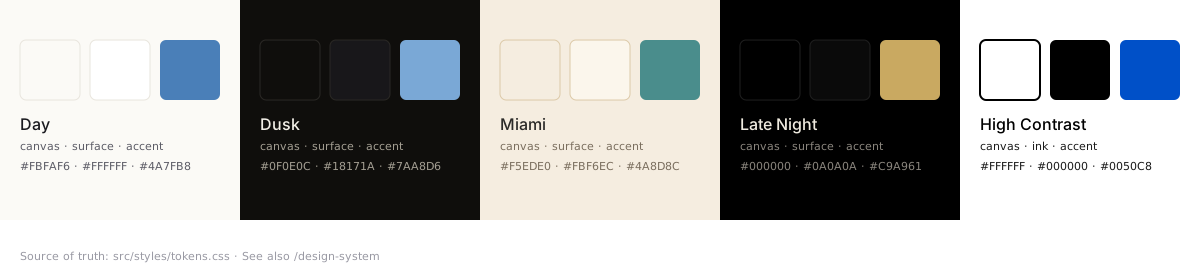
- Color palette (SVG) Five themes, canvas · surface · accent



Pitch templates
Drafts for cold-emailing specific outlets. These are starting points, not final language.
These are drafts. The intent is to seed the shape of pitches to specific outlets and angles; the final language is Pat’s to refine.
The design-press angle (draft)
For publications and writers focused on craft, typography, and visual design.
Subject: a Bluesky client built around editorial typography
Hi [name],
Lanai is a Bluesky client I’m building that treats typography the way a reading app does, not the way a feed does — optical-sized serifs, comfortable line lengths, real vertical rhythm. The headline feature is post-as-image export with editorial templates that travel with the post. It’s in TestFlight now.
I’d love to send you the TestFlight invite and a small set of export samples. The design system documentation is also unusually open, in case the “how it was built” angle is interesting in its own right.
Thanks for your time — Pat
The accessibility angle (draft)
For accessibility-focused writers and outlets where AX5-as-baseline is the lead.
Subject: an iOS app where AX5 Dynamic Type is the design baseline, not the accommodation case
Hi [name],
I’m building a Bluesky client called Lanai whose accessibility approach is inverted from the usual one. Instead of bolting Dynamic Type, contrast, and VoiceOver onto a default-sized design at the end, we designed everything starting from AX5 Dynamic Type and the High Contrast theme, with the smaller-default-sized layouts as the derivative. Screenshots at AX5 are as composed as screenshots at default.
If that’s an angle that interests you, I’d love to share a TestFlight invite and the design system documentation.
Thanks — Pat
The “how it was built” angle (draft)
For tech reviewers and outlets interested in AI-assisted native development specifically.
Subject: a thirty-year multidisciplinary practitioner’s first native app, built with AI-assisted coding
Hi [name],
Lanai is my first native Apple-platform app — built with AI-augmented coding the way every previous tool transition in my career has been navigated. The architecture documentation, the design system, and the audit cycles are the part of the story I’d most want to talk about: what AI-assisted native development looks like when the practitioner brings thirty years of media-technology experience to it, and what discipline the work demands to hold up to scrutiny.
I’d be glad to share the TestFlight invite, the codebase architecture docs, and a long-form interview if any of that fits.
Thanks — Pat
(draft) Refinements still to make: tighten subject lines, decide whether to lead with the founder bio or the app, choose a sign-off voice, and add per-outlet customization notes.
Contact
Press inquiries: hello@pixelantern.com
Real address — no forms, no captcha. Replies are not always instant, but they are always sent.